

I cancelled my gym membership in March 2023, and I remember standing in my living room that first Monday thinking: so what now? I had a yoga mat, two dumbbells I'd bought in a wave of optimism, and absolutely no plan. For the first six weeks I did what most people do — I went hard, five or six days a week, until my knees hurt and my motivation evaporated. Then I quit for a month. Then I started again, badly. Then I quit again.
The third attempt stuck, and it stuck because I stopped treating home fitness as a willpower problem and started treating it as a design problem. That's what this article is about: how to build a sustainable fitness routine at home that survives bad weeks, low motivation, small apartments, and the general chaos of being a human being in 2026. Not a 30-day challenge. A system you can still run in November.
Key Takeaways
- Consistency beats intensity — three 25-minute sessions you actually do will outperform five sessions you dread.
- Anchor your workout to an existing daily habit instead of a clock time. This is the single biggest lever for home workout consistency.
- A no-equipment fitness schedule built around push, pull, hinge, squat, and carry covers more ground than any random video playlist.
- Track sessions, not calories burned. Session count is the metric that predicts whether you'll still be training in six months.
- Design for your worst week, not your best one. If your plan only works when life is calm, it isn't a plan.
Why most home routines collapse in under two months
The first thing I noticed when I started tracking my own failures: I never quit because the workout was too hard. I quit because the decision was too hard. Every evening at 7pm I had to renegotiate the whole thing from scratch — what am I doing today, do I feel like it, is the mat still under the sofa, is that dumbbell still missing a collar.
That negotiation is where routines die. Not in the workout. In the fifteen minutes before it.
The motivation trap nobody warns you about
Motivation is a mood, and moods are weather. You cannot build a structure on weather. What you can build on is friction reduction — making the first thirty seconds of the workout so easy that refusing it feels more effortful than doing it.
Concretely, here's what changed for me: I stopped scheduling workouts and started anchoring them. Instead of "train at 7pm," my rule became "after I pour my morning coffee, I put on my shoes and do the first set." That's it. Shoes on, first set, no further commitment required. Roughly 80% of the time the full session happens anyway, because starting is the hard part. The other 20% of the time I do a short version and count it as a win, which keeps the streak alive.
The equipment illusion
I spent about €180 in my first year on home fitness gear. A resistance band set, a kettlebell, an ab roller I used exactly twice. None of it made me more consistent. What made me consistent was a 2-square-meter corner of my living room where the mat stayed rolled out and the dumbbells stayed visible.
Visibility beats variety. If your equipment lives in a cupboard, your routine lives in a cupboard too.
- Keep the mat unrolled, even if it looks messy
- Put the weights where you'll trip over them (slightly annoying, extremely effective)
- Charge your headphones in the same spot every night
- Delete the fitness apps you open out of guilt rather than intent
Key takeaway: you're not fighting laziness, you're fighting decision fatigue. Remove decisions and the routine starts to hold itself up.
Building a minimum viable routine you can't talk yourself out of
Here's a number that reframed everything for me: three sessions of 25 minutes per week. That's 75 minutes. It sounds almost insultingly small, and that's exactly why it works. I ran that for four months before adding anything, and I missed a total of five sessions — versus the eleven I missed in a single month when I was attempting five 50-minute workouts a week.

The minimum viable routine has three properties. It fits in a bad week. It requires no setup. And it's boring enough that you stop dreading it.
How long should home workouts actually be?
Long enough to cover the movement patterns, short enough that you don't negotiate with yourself. For most intermediate trainees, 20 to 40 minutes is the sweet spot. Beyond 45 minutes at home, my own adherence dropped noticeably — partly time, partly the mental weight of "I have to block out an hour."
If you're coming back from a long break, start at 15 minutes. Genuinely. The goal in month one is not stimulus, it's proving to yourself that the slot exists in your day.
The two-day rule (and why it saved my routine twice)
Never miss twice in a row. That's the whole rule. One missed session is noise. Two is the beginning of a new identity — the identity of someone who doesn't train anymore.
I broke this rule in October 2024 during a brutal work stretch, missed nine days, and spent another three weeks crawling back. The comeback cost me more than the missed sessions did. If you want a related angle on protecting the foundations your routine sits on, the link between sleep hygiene and mental health is worth ten minutes of your time — poor sleep quietly destroys training adherence more than any scheduling problem.
Key takeaway: define the smallest version of your workout that still counts, and protect it ruthlessly. A 12-minute session on a terrible day is worth more than a perfect session you skip.
The no-equipment fitness schedule that actually builds strength
You don't need a rack. You need six movement patterns and a way to make them harder over time. That's the entire at-home strength training plan, and everything else is decoration.
| Pattern | Bodyweight option | With minimal gear | Sets × reps |
|---|---|---|---|
| Push | Push-up (any variation) | Dumbbell floor press | 3 × 6–12 |
| Pull | Table row, towel row | Band row, pull-up bar | 3 × 8–12 |
| Squat | Bodyweight squat, split squat | Goblet squat | 3 × 8–15 |
| Hinge | Single-leg hip hinge | Kettlebell deadlift | 3 × 8–12 |
| Carry / core | Plank, dead bug, hollow hold | Suitcase carry | 3 × 30–45 sec |
Two or three sessions a week covering all six patterns is enough to build and maintain real strength at home. I ran a version of this for eight months with nothing but a pull-up bar and a pair of adjustable dumbbells, and my push-up max went from 14 to 31.
How do you progress without adding weight?
Four levers, in order of preference:
- Add reps within the same set range
- Slow the tempo — a 4-second lowering phase turns a push-up into a different exercise
- Change leverage — feet elevated, hands closer, single-leg variations
- Add load, if you have it
Leverage is the underrated one. Most people jump straight to buying equipment when a simple foot elevation would have done the job for another three months.
One more thing worth saying: if your routine is going to survive long term, your recovery has to survive with it. I wrote about the health risks of prolonged sitting a while back, and the overlap is real — a home routine that never leaves the mat still needs walking, standing, and general daily movement to be worth much.
Key takeaway: cover the six patterns, progress through reps, tempo, and leverage before you buy anything, and let walking carry the rest.
Long-term home fitness motivation without relying on willpower
Motivation as a feeling is unreliable. Motivation as a system output is extremely reliable, and you build it with three things: visible progress, low friction, and social consequence.
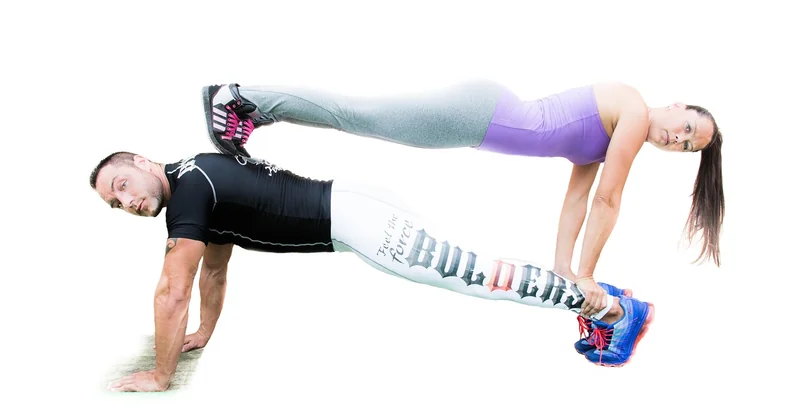
I'll be honest — the social part is the one I resisted longest, because I train at home specifically to avoid people. But I added a single accountability text to a friend: one message a week, just "done" or "missed." That's it. My missed-session rate dropped from roughly one in four to one in nine over the following three months. Same workouts. Same apartment. One text message.
What do you do when you lose motivation completely?
You shrink the workout until it's almost embarrassing, and you do that version. Five push-ups. One set of squats. The point isn't the training stimulus that day — it's refusing to let the identity lapse. Every time I've come back from a slump, it started with a session so small it barely qualified.
If you're dealing with broader burnout rather than just a training slump, the dynamics are similar to what happens to creators who burn out on a content treadmill — the fix is almost never "push harder," it's rebuilding the structure around the work so it stops demanding willpower you don't have.
The habits that compound quietly
- Same time slot, most days — the brain likes predictable cues
- Workout clothes laid out the night before
- A playlist or podcast you only allow yourself during training
- A visible calendar with an X for every completed session
- One rest day you actually take, not one you feel guilty about
Key takeaway: stop trying to feel motivated and start engineering situations where skipping is more effort than showing up.
Tracking, adjusting, and knowing when to change things
Track one number: sessions completed per week. Not calories, not heart rate zones, not how sore you are. Sessions.
I tracked that for a full year. My average came out at 3.4 sessions per week, with a low month of 1 and a high of 5. The low month wasn't a discipline failure — it was a work trip plus a cold, and knowing that in advance is what stopped me from quitting entirely.
Review every eight to twelve weeks. Ask three questions: is the routine still fitting my actual week, am I progressing on at least one lift or variation, and is anything hurting in a way that isn't normal soreness. If the answer to the first is no, change the schedule before you change the exercises.
The mistake I made for two years was changing programs constantly. Every three weeks, a new plan. That's not training, that's shopping. Pick something, run it for three months, and only then decide.
Key takeaway: change the schedule to fit your life, not your life to fit the schedule. And give any program at least eight weeks before you judge it.
Making it stick when the novelty is gone
The routine that lasts isn't the one that excites you most in January. It's the one that still makes sense in July, when it's hot, you're busy, and nothing about a set of push-ups feels novel anymore. That version of the routine is smaller, more boring, and better designed than anything you'll find in a challenge program.

So here's your next action, and I mean this literally: tonight, pick a two-square-meter corner of your home, put your mat or your weights there, and write down the smallest version of a workout you'd be willing to do on your worst day. Three exercises. Fifteen minutes. Do that version tomorrow morning, before you check your phone. Then do it again on Thursday.
That's the whole thing. Everything else — the progressions, the tracking, the equipment — grows out of those first two sessions. And if you only take one idea from this article, take the two-day rule. Never miss twice. It's the cheapest insurance policy a home routine has.
Frequently Asked Questions
How many days a week should I work out at home to see results?
Three sessions per week is the realistic minimum for most intermediate trainees, and it's enough to build strength if you cover the main movement patterns. Two works if the sessions are longer and you're consistent. Five or more sounds impressive but is where most home routines break — I've watched my own adherence fall off a cliff every time I pushed past four.
Can I build real muscle without any equipment at home?
Yes, up to a point. Bodyweight training builds meaningful muscle if you progress through reps, tempo, and leverage — elevated push-ups, single-leg variations, slow eccentrics. What you can't do indefinitely is load the lower body heavily without some external weight. A pair of adjustable dumbbells or a kettlebell covers that gap for most people.
What should I do on days I have zero motivation?
Do the smallest version that still counts. Five push-ups, ten squats, a thirty-second plank. The goal on those days isn't training stimulus, it's keeping the habit chain intact so tomorrow's session isn't a restart. I've done sessions lasting under four minutes that did more for my long-term consistency than any hard workout.
How long before a home routine becomes a habit?
In my experience, somewhere between eight and twelve weeks of reasonably consistent sessions before it stops feeling like a decision. The first month is the fragile part. After that, the anchor cue does most of the work — you stop asking whether you'll train and start just doing it after your coffee or your commute.
Is it better to work out in the morning or the evening at home?
Whichever slot you can defend most reliably. Morning sessions have fewer competing demands, which is why they survive bad weeks better. Evening sessions tend to be stronger physically but get cancelled more often. Test both for two weeks and keep the one you actually completed more of — not the one that felt better in theory.


