

You've probably already tried the obvious. Joined a gym in January, wandered between machines, done some bicep curls because they're the only thing that felt familiar, and left after twenty-five minutes. Then your knees ached for two days for no good reason and you quietly decided that lifting was a young person's game.
It isn't. What changes after 40 isn't your ability to build muscle—it's your recovery window, your joints' tolerance for sloppy form, and the amount of time you can realistically protect for yourself. Get those three things right and the best strength training exercises for women over 40 are, honestly, unglamorous: a hinge, a squat, a push, a pull, something for the back of your shoulders, and a walk while carrying something heavy.
I'll walk you through the exact movements, how often to do them, and the mistakes I made myself—including the year I spent doing too many reps with too little weight and wondering why nothing changed.
Key takeaways
- Two to three full-body sessions per week beats five scattered ones at this stage of life.
- Compound movements (squat, hinge, push, pull) do most of the work—isolation exercises are the seasoning, not the meal.
- Progressive overload means adding small amounts of weight or reps over weeks, not chasing soreness.
- Recovery, sleep, and enough protein matter as much as the workout itself after 40.
- If a movement hurts a joint (not the muscle), swap it instead of pushing through.
Why the rules change after 40 (and which ones don't)
Muscle doesn't pack up and leave on your 40th birthday. What happens is subtler: recovery from a hard session stretches out, tendons and ligaments get less forgiving of a loaded position your body isn't used to, and if you're in perimenopause or menopause, the hormonal shifts affect how you lay down and hold onto muscle. None of that means less training. It means better-targeted training.
What actually changes
Two things I noticed in my own training, and that I now plan around rather than fight:
- Warm-ups stop being optional. Five minutes of easy movement before loading a barbell is the difference between a good session and a twinged lower back. I learned that one in a hotel gym in Lisbon, and I'm still slightly annoyed about it.
- Volume needs to be earned. Doing eight sets of squats because a program from your twenties said so will leave you wrecked for four days. Two or three hard sets per movement is plenty when you're starting.
- Joints speak up sooner than muscles do.
What doesn't change
Muscle still responds to tension and to progressive overload. That is the whole mechanism: put a load on a muscle, create enough mechanical tension, give it a reason to grow, then feed and rest it. Hormones modulate the response—they don't switch it off. I've watched women in their fifties add load to a Romanian deadlift month after month, and the reason was never a clever exercise: it was showing up twice a week with a notebook and adding a bit more.
Which brings up the part nobody likes to hear. If you're lifting weights to lose weight, strength training is the thing that changes your shape and protects your muscle while you're in a calorie deficit—but it isn't a calorie burner in the way a spin class is. Do both. Don't expect the barbell to do the treadmill's job.
The six movements that do 80% of the work
Every good program I've built for myself or written for friends comes back to the same handful of patterns. Pick one exercise from each row, do three sets of each, and you have a full-body session that takes about 40 minutes including warm-up.
| Pattern | Best pick for over 40 | Why this one |
|---|---|---|
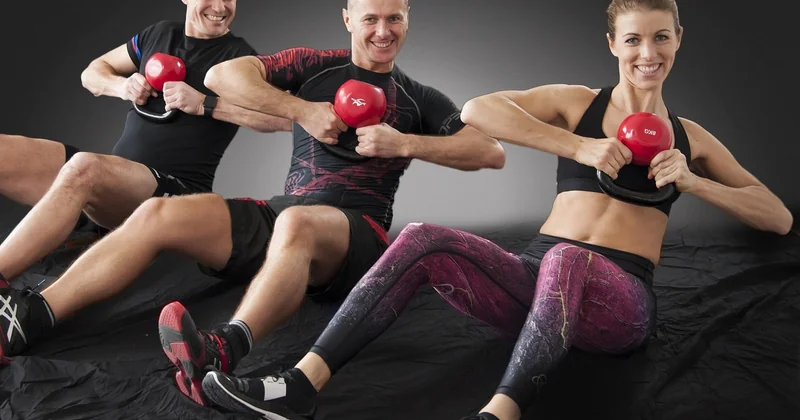
| Squat | Goblet squat (dumbbell or kettlebell at chest) | Teaches you to brace and keeps the load in front, which is gentler on the lower back than a heavy back squat |
| Hinge | Romanian deadlift with dumbbells | The single best exercise for glutes and hamstrings, and the one most women have never been taught |
| Push | Dumbbell bench press or incline press | Loads the chest and triceps without the shoulder strain of a barbell bench |
| Pull | Seated cable row or one-arm dumbbell row | Counters the forward posture most desk work creates |
| Vertical pull | Lat pulldown, or assisted pull-up if available | Keeps the upper back and grip working |
| Carry | Farmer's walk, two heavy dumbbells, walk 20–30 metres | Trains grip, core, and posture at once—three sets of walking with weight in each hand |
The hinge you're probably doing wrong
The Romanian deadlift is not a squat with a bar in your hands. Push your hips back like you're closing a car door with your backside, keep a soft knee, and stop lowering the moment your hamstrings tell you they've had enough—usually around mid-shin for most people. If you feel it in your lower back rather than the back of your thighs, you've gone too low or let the weight drift away from your legs. Start with two dumbbells you could comfortably curl for ten reps, then add weight only when all three sets feel controlled.
The exercise I almost skipped and shouldn't have
Rows. For two years I treated back work as filler. Then I spent a week with a stiff neck from sitting at a laptop and realised my pull volume was roughly a third of my push volume. Bringing those into balance (two pulling sets for every pushing set, roughly) fixed it faster than any stretching routine. Pull more than you push—it's a decent rule of thumb for anyone who spends their day in front of a screen.
How often should a woman in her 40s lift weights?
Two to three full-body sessions a week is the sweet spot. That's enough frequency to build strength and enough rest to recover between sessions—48 hours between them is a reasonable gap, so Monday/Thursday or Monday/Wednesday/Friday works well.
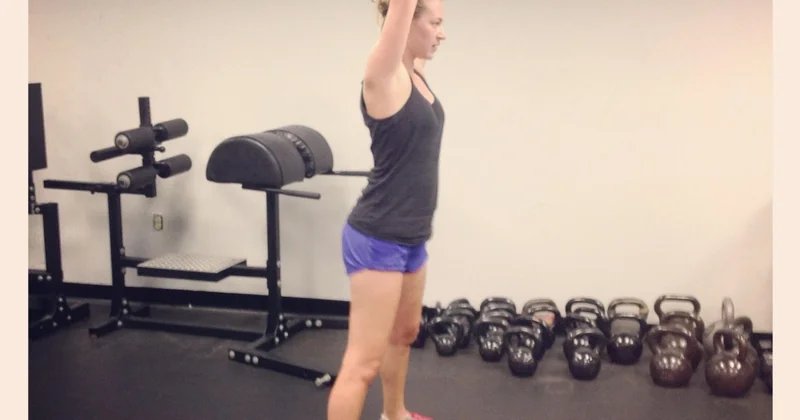
If you're brand new to lifting, start with two. Not because you can't handle three, but because the first few weeks are about learning positions and letting your tendons catch up to your enthusiasm. I've watched more than one friend jump straight to five days, last eleven days, and then not touch a dumbbell for three months. The compound movements above cover the whole body in 40 minutes, so three sessions is genuinely enough.
How to progress without wrecking yourself
Progressive overload sounds technical; in practice it looks like this:
- Week 1–2: pick a weight you can do for three sets of eight reps with two reps left in the tank.
- Week 3–4: same weight, aim for ten reps per set.
- Week 5: add the smallest jump your gym allows—usually 2 kg per dumbbell, or one plate on a machine—and drop back to eight reps.
- Repeat. Take a lighter week every six to eight weeks.
Write it down. The notebook is the program. Without it you'll spend a year doing roughly the same session and wondering why your legs look the same.
What is the 3-3-3 rule for working out?
The 3-3-3 rule is a simple session template: three exercises, three sets each, three reps per set—done with a heavy enough load that those three reps are genuinely hard.
It's a real approach, and it works because it forces you to respect intensity over volume. Three heavy sets of three on a squat or a deadlift is a legitimate strength session. But it isn't a great fit for a beginner, and here's where I'd push back on how it's often presented: three reps per set demands near-perfect technique and a decent sense of what "hard but controlled" feels like. Most people starting out at 40 don't have that yet.
My view: use the 3-3-3 structure as a template for how compact a session can be, not as a prescription for load. Three exercises, three sets, and choose a rep range that leaves you two reps short of failure—eight to twelve is a safer starting point. Then, as your technique tightens up over a few months, you can experiment with heavier triples on one or two lifts.
What weight should a 40 year old woman be able to lift?
There is no meaningful number. Anyone who hands you a figure without knowing your training history, bodyweight, and injury record is guessing. Strength isn't a fixed target you either meet or fail—it's a direction of travel.
A more useful question: what should the weight feel like? For a working set in that eight-to-twelve rep range, the last two reps should be a genuine effort, and you should be able to keep your form. That's it. That's the standard.
Two practical anchors instead of numbers:
- Goblet squat: start with a dumbbell or kettlebell you can hold at your chest for three sets of eight. Many women start somewhere in the 8–12 kg range and add from there.
- Farmer's walk: two dumbbells you can carry for 30 metres without your grip failing or your shoulders rounding forward.
Equipment varies wildly between gyms—a hotel dumbbell rack might jump from 10 kg to 15 kg with nothing in between, which is why adjustable dumbbells are worth the money if you train at home. And if you've never lifted before, a single session with a qualified coach to check your hinge and squat setup is the best money you'll spend on this whole project. It's the difference between a foundation and a recurring ache.
How to build muscle in your 40s as a female
The formula is boring and it works: enough tension, enough protein, enough sleep, repeated for months.
The half of the equation people skip
Training is the stimulus. The growth happens afterwards, and after 40 the "afterwards" needs more support than it used to. That means:
- Protein at every meal, not just a shake after the gym. If you're not sure you're getting enough, that's worth attention before you add a fourth training day.
- Sleep. A hard session on five hours of sleep is a hard session you'll pay for.
- Walking. Daily low-intensity movement helps recovery and keeps the joints happy—it's not "cardio," it's maintenance.
Three mistakes I made so you don't have to
First, I spent months doing three sets of fifteen with light dumbbells because someone told me high reps were "toning." I got bored and I got no stronger. Second, I added exercises instead of adding weight—more variety, same stimulus. Third, I trained through a shoulder niggle for six weeks and lost three months of pressing. Swap, don't push through. A neutral-grip press instead of a straight-bar press is not a defeat.
What I'd do differently if I started over at 40: two sessions a week, the six movements above, a notebook, and a coach for one hour to check my form. Nothing exotic. The women I know who've done this consistently for a year don't look like they've been "on a program"—they just look like themselves, standing straighter, carrying the shopping without thinking about it.
Which might be the real argument for starting. Not the before-and-after photo, but the fact that in ten years you'd like to get off the floor without using your hands. That's a benchmark you can actually test tonight, in your living room, and again in six months. Try it now—then come back to the goblet squat.


