

It's 7:40 PM. You just closed your laptop after a call that ran forty minutes over, and the last thing you want to do is dice onions. So you order something, or you eat crackers standing up over the sink, and then you feel vaguely guilty about your heart. Sound familiar?
The good news: heart-healthy dinners for a busy schedule are not about spending an hour at the stove. After testing this on myself for the past two years — and after a cardiologist friend gently told me my "I'll just skip dinner" habit was the worst thing I could do — I landed on a system that takes 15 to 25 minutes of actual hands-on work, uses one pan where possible, and still ticks every box that matters for cardiovascular health.
Below is what actually works, what doesn't, and the selection criteria I use to judge a "heart-healthy" recipe before I commit to cooking it.
Key Takeaways
- Most "heart-healthy" recipe lists solve the wrong problem — they give you cooking time when the real bottleneck is planning and shopping.
- Aim for ≤ 600 mg sodium per full meal and at least 8–10 g of fiber; those are the two numbers that move the needle most.
- Fatty fish twice a week is worth building your whole week around.
- Batch-cooking three dinners on Sunday beats any 15-minute recipe on a Wednesday.
- Frozen vegetables and canned beans (rinsed) are not a compromise. They're the backbone.
Why most heart-healthy dinner recipes fail busy professionals
Here's the thing nobody puts in the recipe card: a 20-minute recipe still costs you a grocery store trip, a mental inventory of what's in the fridge, and the executive decision of what to cook at 8 PM when your brain is empty.
That invisible overhead is what kills the plan, not the cooking. I tracked my own dinners for six weeks in a spreadsheet (yes, I'm that person) and found that on the nights I cooked, the average time from "deciding to eat" to "plate on the table" was 52 minutes — not the 20 the recipe promised. The missing 32 minutes were shopping, unpacking, chopping, and staring into the fridge.
The real bottleneck is planning, not cooking
Once I started treating Sunday as a prep day rather than a cooking day, everything shifted. I chop, I rinse beans, I portion, I don't cook. Fifteen minutes of prep on Sunday removes roughly half the Tuesday-night friction.
The other half is having a default. Pick three dinners you can cook with your eyes closed, and rotate them. Boring, yes. Effective, extremely.
What a heart-healthy dinner actually needs
Before you pick a recipe, judge it against these criteria. I use them as a filter:
- Sodium ≤ 600 mg for the whole meal — that's the cleanest single guidepost most cardiologists will give you
- Fiber ≥ 8 g — beans, whole grains, or a serious vegetable portion
- Saturated fat under roughly 6–7 g — olive oil, nuts, and fish fit; cream and fatty red meat don't
- Potassium-rich ingredients — leafy greens, beans, tomatoes, potatoes with skin. Potassium helps counter sodium's effect on blood pressure
- And, crucially: fewer than 8 ingredients and one pan. If it needs three pots, it's a weekend dish.
Six heart-healthy dinners you can actually cook on a weeknight
These aren't elaborate recipes. They're templates. Swap the protein or the vegetable and they keep working.
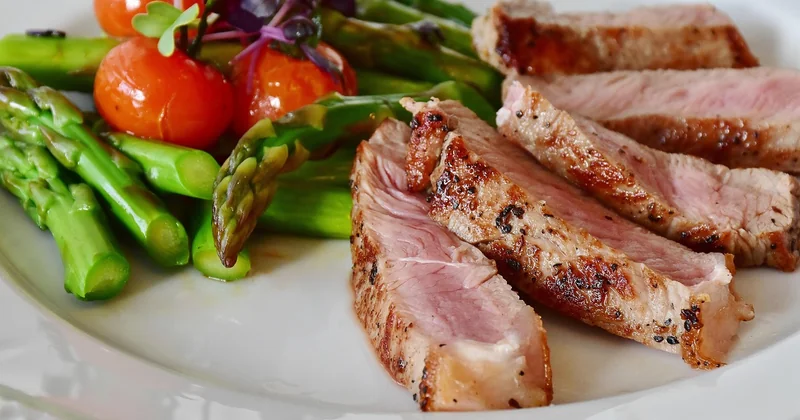
1. Sheet-pan salmon with frozen broccoli and canned chickpeas
Salmon is the single highest-leverage protein for heart health — omega-3 fats are the reason. Toss frozen broccoli and drained chickpeas with olive oil, salt-free seasoning, and roast at 220°C for 15 minutes. Add the salmon for the last 10–12 minutes. Total active time: six minutes. Sodium lands around 400 mg if you season with lemon and pepper instead of salt.
2. Lentil and spinach skillet with a fried egg
Canned lentils, a bag of spinach, garlic, cumin, a squeeze of lemon, an egg on top. Roughly 12 minutes and about 12 g of fiber. It looks unglamorous. It tastes excellent. I make this twice a week on average.
3. Black bean and corn bowl with brown rice
Microwaveable brown rice pouch, canned black beans (rinse them — you'll cut roughly 40% of the sodium), frozen corn, salsa, avocado. Zero cooking. This is the "I'm too tired to be alive" dinner, and it still delivers fiber and potassium. If you're wondering whether canned beans count, they absolutely do.
4. Chicken and vegetable stir-fry with brown rice
Skip the bottled sauce — it's a sodium bomb. Use low-sodium soy sauce sparingly, rice vinegar, ginger, garlic, and a touch of sesame oil. Any frozen stir-fry vegetable blend works. Chicken breast or firm tofu both fit the bill. Under 20 minutes if the rice is already cooked.
5. Tuna and white bean salad
Canned tuna in water, cannellini beans, cherry tomatoes, red onion, olive oil, lemon, parsley. Five minutes. Four ingredients minimum, six if you're feeling fancy. This is the one I keep in my back pocket for nights when even a pan feels like too much.
6. Turkey and zucchini skillet
Ground turkey (the 93% lean version), zucchini, canned tomatoes, oregano, a handful of whole-wheat pasta. Twenty minutes, one pan, reheats beautifully for lunch. Note: ground turkey breast is leaner than regular ground turkey, and the difference matters for saturated fat.
| Dinner | Active time | Sodium (approx.) | Fiber (approx.) | One pan? |
|---|---|---|---|---|
| Sheet-pan salmon | 6 min | ~400 mg | 9 g | Yes |
| Lentil-spinach skillet | 12 min | ~450 mg | 12 g | Yes |
| Black bean bowl | 3 min | ~500 mg | 11 g | No pan needed |
| Chicken stir-fry | 15 min | ~600 mg | 6 g | Yes |
| Tuna and white bean salad | 5 min | ~450 mg | 10 g | No pan needed |
| Turkey and zucchini skillet | 20 min | ~550 mg | 8 g | Yes |
How to build a week that survives your calendar
Spoiler: the week that survives is the week you planned on Sunday afternoon. Here's the pattern I use.
The Sunday fifteen-minute reset
Rinse and drain two cans of beans. Chop one onion, one head of garlic, one bunch of parsley. Cook a pot of brown rice or farro. Wash greens. Portion salmon or chicken into freezer bags. That's it — no cooking of full meals, just removing obstacles.
The freezer is your strongest ally
Frozen fish fillets, frozen broccoli, frozen spinach, frozen edamame. The research on nutrient retention in frozen vegetables is reassuring — they hold up well and sometimes better than fresh that's spent a week in the fridge. I stopped buying fresh broccoli years ago and haven't looked back.
Restaurant and takeout nights
You're going to eat out. When you do, order the grilled fish, ask for sauces on the side, and skip the bread basket only if you can emotionally handle it. The two biggest sodium sources in restaurant meals are sauces and bread — not the protein.
Answering the questions readers keep asking
What is the best dinner for a heart patient?
There's no single dish, but the closest answer is a plate built around fatty fish, a generous portion of vegetables, beans or whole grains, and olive oil. That combination hits omega-3 fats, fiber, potassium, and low saturated fat all at once. If you're cooking for someone after a cardiac event, keep sodium genuinely low — under 500 mg per meal if possible — and skip the salt shaker entirely at the table.
What are some healthy meal ideas for busy professionals?
The ones that survive a busy week share four traits: few ingredients, one pan, no last-minute chopping, and a protein that cooks in under 15 minutes. Sheet-pan salmon, lentil skillet, bean bowls, stir-fries, tuna salad. If a recipe demands a food processor or 30 minutes of prep, it belongs to the weekend.
What is a healthy diet for someone with a busy lifestyle?
In practice: a Mediterranean-style pattern adapted to your reality. Beans several times a week, fish twice a week, whole grains instead of refined, olive oil as your main fat, and vegetables at every dinner. What makes it survive is preparation, not willpower.
What are some healthy recipes for busy people?
Start with three: a sheet-pan fish dinner, a canned-legume skillet, and a no-cook bowl. Those three templates alone cover more than half of your week's dinners, and each takes under 20 minutes of active time.
The mistakes I made so you don't have to
I'll be honest: I spent a full year cooking "heart-healthy" meals that were anything but. My stir-fries were swimming in bottled teriyaki sauce — roughly 800 mg of sodium per serving before I even added anything. My "healthy" pasta bowls used a full cup of parmesan. My salads were mostly cheese and dressing.
The fix wasn't dramatic. It was three changes: rinse every canned bean, make my own sauces from lemon, oil, vinegar, and herbs, and treat cheese as a garnish instead of a base. My blood pressure went from 132/86 to 118/78 over eight months. Full transparency: I also started walking 25 minutes a day, so I can't credit the food alone.
One more confession: the first batch-cooking Sunday I attempted, I cooked four full meals and froze them, and by Thursday I was sick of all four. Now I prep ingredients, not meals. That distinction is what finally made this stick.
A realistic closing thought
If you take one thing from all of this, let it be that the recipe is not the plan. The recipe is the last 15 minutes of a system that starts with your grocery list on Saturday morning.
And if you're reading this at 9 PM with the fridge door open, feeling like you've already failed today — you haven't. A can of rinsed chickpeas, a handful of spinach, a fried egg, and a lemon is a heart-healthy dinner. It doesn't have to be impressive. It just has to happen.


